
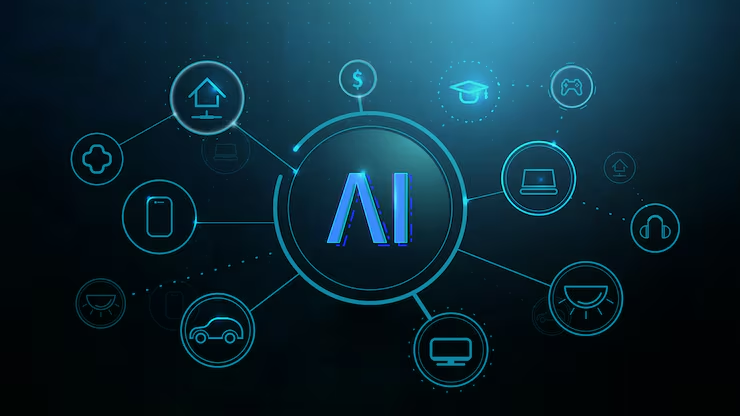
Artificial Intelligence has evolved from an experimental concept into a core enabler of modern business. Today,...

AI integration bridges this gap by:
• Enhancing legacy systems rather than replacing them
• Delivering measurable value with lower adoption barriers
• Helping teams make faster, data-backed decisions
• Unlocking efficiencies that scale across operations
Rather than a one-time project, integration transforms the organization into a continuously improving system capable of learning and evolving.
Common areas of impact include:
• Customer engagement: AI-powered chat, personalization, and support
• Operations: Automated tasks, demand forecasting, and smarter resource planning
• Risk assurance: Fraud detection, anomaly identification, compliance monitoring
• Sales & marketing: Lead prioritization, campaign intelligence, predictive conversion modeling
• Product experience: Intelligent recommendations, contextual search, adaptive journeys
By integrating AI directly into existing platforms, teams adopt enhancements naturally—never forced to learn unfamiliar systems.
Modern AI tools introduce capabilities that businesses can deploy incrementally:
• Machine learning: Models that learn from historical and real-time data
• Predictive analytics: Forecasting demand, behavior, and risk
• Natural language processing: Understanding text, speech, and customer intent
• Computer vision: Recognizing patterns, objects, and documents
• Automation & RPA: Removing repetitive manual work from workflows
These capabilities convert previously static systems into responsive, adaptive environments.
Successful AI adoption requires a strategic, phased approach. The most important steps include:
• Identify high-value use cases where automation or insight unlocks the most benefit
• Assess the data landscape and bridge gaps in quality or accessibility
• Start small and scale through pilots, proof points, and incremental enhancements
• Measure outcomes continuously to maximize return and operational adoption
By treating AI integration as an iterative journey—not a single milestone—organizations reduce risk while accelerating impact.

Artificial Intelligence has evolved from an experimental concept into a core enabler of modern business. Today,...

Artificial Intelligence has evolved from an experimental concept into a core enabler of modern business. Today,...